Sentimental Value (2024) 8/10
JOACHIM TRIER/RENATE REINSVE-A BRILLIANT COLLABORATION

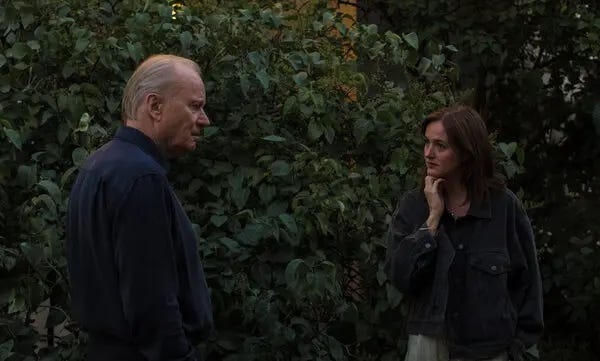
In Sentimental Value, director Joachim Trier reunites with actor Renate Reinsve, continuing one of European cinema’s most compelling contemporary collaborations. Though Reinsve appears briefly in Trier’s Oslo, August 31st (2011), the partnership truly emerged with the excellent The Worst Person in the World (2021), which turned her into an international sensation and earned her the Best Actress prize at Cannes. The film also went on to receive Academy Award nominations for both Best Foreign Film and Best Original Screenplay. Trier wisely realized that Reinsve has a face the camera reads effortlessly, as if thought itself were visible, and structured two films around it. I would rate The Worst Person in the World eight out of ten, and I heartily endorse it.
Joachim Trier’s two latest films approach adulthood from opposite directions. The Worst Person in the World follows a character largely unshaped by a fixed past, burdened instead by the terror of open possibility. Sentimental Value, by contrast, is defined by what has already happened-a generational inheritance wherein emotional patterns pass down through a family almost epigenetically. It examines the aftermath of a mother’s collapse and a father’s inability to answer it, and the damage carried by their children. His distance from them, and from his own feelings, is not so much chosen as learned.
In The Worst Person in the World, Reinsve’s character Julie moves from one possible life to another-as a student, a photographer, a partner-never quite settling on who she is. Trier lets the film wander with her, building it out of moments rather than plot turns. In one of the film’s most memorable sequences, Julie steps outside and finds Oslo frozen in place-cars are stopped at intersections, pedestrians are suspended mid-gesture, even a dog is caught in motion. She moves silently through the city to find the barista she met the night before, the moment less a fantasy than a visual expression of acting on an impulse before doubt has time to return. In the end, the film defines adulthood as something that is not an arrival, but a series of choices. Here, Reinsve’s character Julie lives inside possibility, while in his next film, he examines characters shaped by consequence.
Sentimental Value is centered around the aging, once-celebrated film director Gustav Borg (Stellan Skarsgård), who abruptly returns to the orbit of his two adult daughters after years of emotional and physical absence. In the opening scenes, Nora (played by Reinsve) is an actor unraveling backstage, struggling to go onstage, and her temperament borders on caricature-a classic diva panic. We learn that she is a rising star, in sharp contrast to her father, who has not yet appeared, but is about to reenter her life. His career has quietly faded, and after a fifteen-year absence he returns with a new film. When he does return to his daughters, it quickly becomes clear that he is less interested in reconciliation than leveraging his daughter’s newfound prominence to support his project-a film confronting his wife’s suicide, the trauma that widened the schism between Nora, her sister Agnes (Inga Ibsdotter Lilleaas) and their father. It soon becomes evident that he would like Nora to play the role of her mother and to shoot the film in their grief-soaked home that she still inhabits- a proposal she adamantly rejects.
Skarsgård, the scion of Sweden’s premier acting family, delivers his typically top-notch performance as Gustav, the vain and cold once-celebrated director who is seeking to return to past glory. After Nora’s initial rejection, he turns to bright young American star Rachel Kemp (Elle Fanning, in a fine performance), who acts as an outsider’s foil to the family’s deep-seated wounds. Gustav first meets Kemp at a festival screening one of his earlier films-the only one in which Agnes, not Nora, appears as a child actor. That earlier work, set against the backdrop of World War II grapples with inherited psychological scars, suggesting a lineage of damage stretching from Gustav’s mother-and her possible suicide-into the next generation.
Trier’s decision to make Agnes, the former child performer, ultimately reject an artistic life, is a brilliant one. Now a historian, she stands in direct contrast to her actress sister, whose life is somewhat of mess and remains unsettled and volatile. Agnes has become Nora’s emotional ballast-a reversal of childhood roles, when the older sister once shielded and comforted the younger in the aftermath of their mother’s death. I should note that Lilleaas’ performance is every bit as nuanced and powerful as those of Skarsagård’s or Reinsve’s- a judgement evidently shared by awards voters, as she received Best Supporting Actress nominations from both the Golden Globes and the Academy Awards.
Returning to the story, it is clear that Kemp idolizes Gustav, and agrees to take on the role of Agnes and Nora’s mother, even to the point of dying her hair to resemble her. As work begins, the childhood home becomes a character unto itself-a literal repository of memory-and the boundary between lived experience and the script grows uncomfortably blurred. In the end, it is Kemp who recognizes that she is miscast. The realization comes as she attempts to read an extended monologue in English, nobly striving to capture its emotional force, but eventually and correctly concluding that the speech demands linguistic and cultural authenticity-something she cannot convincingly provide. Ultimately, Nora somewhat reluctantly agrees to take the demanding part despite her trepidation and bitterness, recognizing it was written for her all along, and that, in his own way, Gustav is trying to make peace with her through the film.
Trier, along with his cinematographer and editor, ultimately succeeds because the family dynamics and performances feel lived and not engineered. He gives these magnificent actors the direction, script and space to patiently work through their shared difficulties and history, allowing them to fully disappear into the characters with quiet conviction-which they all do admirably. As in Chloe Zhao’s beautiful film Hamnet (2025), also reviewed on this site, art becomes a response to grief. An artist’s reaction to tragedy and trauma may not be immediately palpable or visible, it is often concealed beneath conflicting emotions and personal foibles. But when the dust settles, it is recognizable and true.
As always, I recommend a visit to your local theater for the most complete cinematic experience, and even at first run prices, Sentimental Value is well worth your investment. Nonetheless, it is also now available on Prime for ten bucks. Either way, don’t miss it.